Network scientists solve one of the biochemical mysteries of malaria
6th October 2006
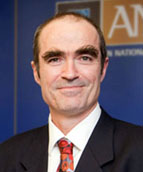
Prof Kiaran Kirk, Head of the School of Biochemistry and Molecular Biology (BaMBi) at the Australian National University (ANU) and Prof Geoff McFadden, at the University of Melbourne won a Network travel award for Researcher Exchanges between their labs for their work on the malaria parasite Plasmodium falciparum. Their collaborative research has resulted in a Nature paper published 6 October 2006 and Roselani Henry, Megan Downie and Dr Kylie Mullin, three of the young researchers from their labs who all took part in this Researcher Exchange are profiled here.
Roselani (Lani) Henry and Megan Downie are both about to complete their PhD's at ANU. Both researchers work in Kiaran Kirk's lab where they study the physiology of the malaria parasite,Plasmodium falciparum, and apply their knowledge to identify new drug targets and investigate how drugs can be targeted to the malaria parasite. Their research focuses on the point of the parasite's lifecycle where it lives in the red blood cells of human hosts and how the parasite takes up its nutrients and transports them across the red blood cell membrane into the malaria parasite, and also how it gets rid of its waste products. Lani is particularly interested in the transport of ions into the malaria parasite whilst Megan's research focuses on nucleosides.
All three were all part of a collaborative research project published in Nature today (Vol 443, 582-5). The study reveals why the malaria parasite, Plasmodium falciparum, increases the sodium content inside its host's red blood cells. The increase sodium content of the host cell enables the parasite to use a sodium-powered transport system to 'steal' an essential nutrient - inorganic phosphate - from the host cell.
Dr Kevin Saliba and Dr Rowena Martin are joint first authors of the study which, as well as the Kirk and McFadden labs, involved another ANU lab, headed by Associate Professor Stefan Bröer. A bioinformatic analysis led to the hypothesis that the parasite encodes a sodium-dependent transporter for inorganic phosphate. Using parasites isolated from their host blood cells the team showed that the uptake of phosphate by the parasite is energised by sodium. They then cloned the transporter and expressed it in frog oocytes, showing that its physiological characteristics matched those of the pathway involved in the uptake of phosphate into the parasite.
As part of the study, Lani travelled to Geoff's lab in Melbourne, supported by the Network Travel Award, with the aim of accessing the McFadden lab's expertise in using parasite transfection technology to tag and localise malaria parasite proteins. Lani's aim was to find out precisely where in the parasitised red blood cell the phosphate transporter is located. She showed that it was localised to the surface of the parasite, perfectly positioned to take advantage of the increased sodium content of the host cell compartment. A long-term collaboration has been established through this Researcher Exchange and since then scientists in the Kirk lab have been using these new techniques to investigate other transport proteins in the malaria parasite. Megan is currently at the University of Melbourne using these techniques to investigate nucleoside transporter proteins.
Also as part of this Researcher Exchange, Kylie travelled to Canberra to try to express the apicoplast triose-phosphate transporters in frog oocytes using techniques taught by the ANU team. She is still working on this technique and said that the collaboration has been invaluable. Kylie is fascinated by the apicoplast and says that there is a real need for cell biology research on Plasmodium and so much potential for future research and that this keeps her interested and motivated. A highlight for Kylie was the latest paper she worked on "Membrane transporters in the relic plastid of malaria parasites" published in PNAS (2006, Vol 103, 9572-7). We wish Kylie all the best in her quest for knowledge about the apicoplast and hope that she continues to enjoy her research work.
Lani believes that the team have answered a biological problem and have gained more information about the malaria parasite's physiology as a result of this research. Both Lani and Megan are fascinated by this malaria parasite, in particular its physiology and the fact that it hides in the human red blood cell as part of its lifecycle. Lani also enjoys working on such an important health problem. "We need to develop new malaria drugs and understand the mechanism of drug resistance so that we can learn how to administer these drugs in a way that avoids the development of drug resistance." Lani said.
Megan really enjoys the collaborative nature of science research; next year she will move to Oklahoma City in the US to take up a postdoctoral position with Ira Blader at the University of Oklahoma to work on Toxoplasma. She is looking forward to learning new techniques as well as experiencing a difference research environment and we wish her all the best.
Lani said the Researcher Exchange was a highlight of her career; she enjoyed travelling to Melbourne and working with different people to learn new techniques. Lani enjoys her research and sees her future in science research and medicine and we wish her all the very best.
|


