

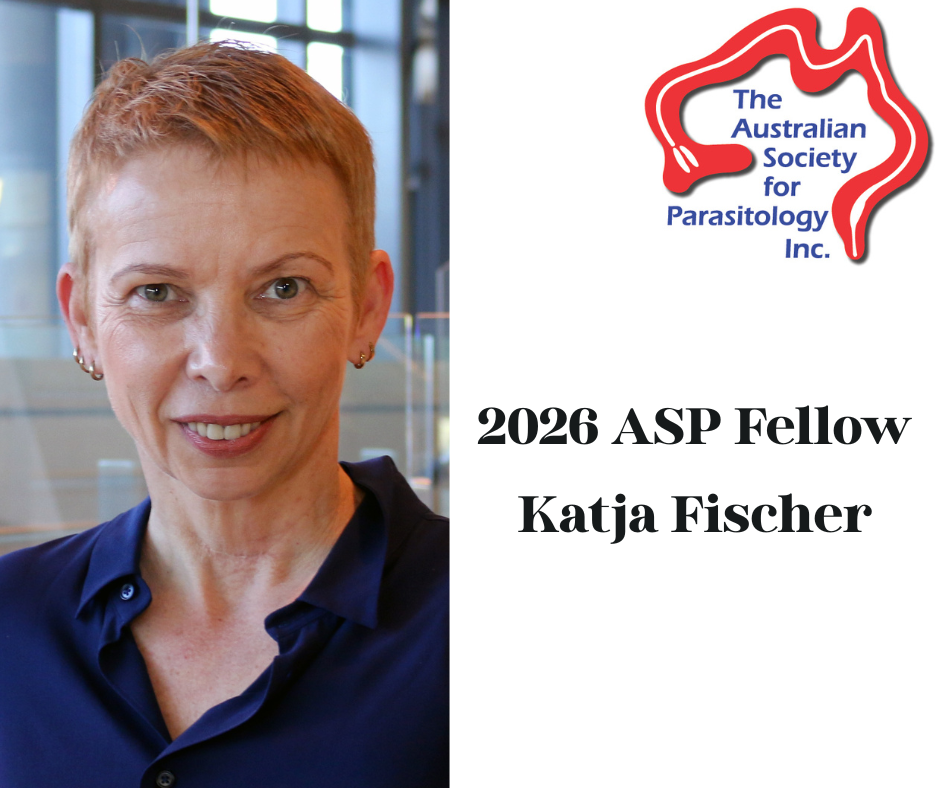
For her contributions to parasitology and the ASP, Katja Fischer is a deserving recipient of the award of Fellow of the Australian Society for Parasitology.
Citation
We would like to nominate Katja Fischer as a Fellow of the Australian Society for Parasitology
Contribution to the filed of Parasitology and to the Society:
A/Prof. Katja Fischer is a senior group leader and global authority in acarology with >22 years in scabies research. She received the Bancroft-Mackerras Medal (2020), QIMRB Bancroft Medal (2023), and was invited to apply for a Level E conjoint role at UQ (2025).
She has led a pioneering research program that transformed scabies from an observational condition into a molecularly defined disease, shaping the global scabies research agenda. Of her >140 peer-reviewed publications (>88% in Q1 journals), >80 relate to this program; she is the first/senior author on >75% of those, with one-third in top-ranked journals. She secured ~$13M in research funding (~98% as CIA/PI), including four major grants since 2019: NHMRC Project (CIA), NHMRC SRF (2019), and two Dioraphte Foundation grants (2020, 2024). Her work is cited in >40 policy documents. As the most cited author in scabies basic research (Web of Science), I rank in the top 0.1% on Expertscape and top 0.5% for NTDs (ScholarGPS). She co-chair WHO Discovery Research Working Group (skin NTDs, 2025), co-founded IACS, and has supervised 15 PhDs, 16 Masters/Honours, and 7 postdocs.
At her program onset, virtually no molecular tools existed. She addressed this by, (i) developing and maintaining the world’s only porcine scabies model since 2006 (the critical resource for advancement of scabies pathophysiology and enabling breakthroughs in multi-omics, scabies biology, and acaricide studies), (ii) establishing foundational molecular resources, including the first transcriptome, proteome, and de novo assembled nuclear and mitochondrial genomes, recombinant proteins and crystal structures, and functional tools like RNAi. These resources catalysed the field, as they enabled global research on diagnostics, drug resistance, immune evasion, and pathogenesis and (iii) Dissecting molecular interactions between scabies mites and bacteria, influencing treatment guidelines and prompting the formation of an internationally funded ($1.4M) global scabies microbiome consortium. She led development of the key scabies animal model, first recombinant proteins, and major molecular datasets.
Katja’s contribution to the filed reflects in many layers, translational, industry, and policy leadership. She led over $400K in industry-funded R&D, including as consultant for Hatchtech Pty Ltd on repurposing Xeglyze™ (FDA-approved for head lice) for scabies. She collaborated with Phytomed (NZ), AnteoTech (Australia), led international contracts with NIAID (USA), as well as initiated partnerships with Boehringer (USA) and Abington Health (UK). As a founding member and scientific advisor of the International Alliance for the Control of Scabies (IACS), she helped shape global research and control policy. She contributions supported WHO’s recognition of scabies as an NTD in 2017. In 2025, She was appointed Co-Chair of the WHO Discovery Research Working Group for Skin NTDs. She also contribute to the development of the S2k guideline on scabies through a nominated expert panel led by the German Dermatological Society and dEBM at Charité, Universitätsmedizin Berlin. Her work has directly influenced public health guidelines in Australia, Europe, and the Pacific. Notably, her research with Orange Sky Australia contributed to the revision of Australia’s guidelines on rheumatic fever (2022), and has been cited in policy documents and clinical guidelines from Ireland, Spain, and Belgium. Since 2023, she has served as a scientific advisor to the ongoing ‘Healthy Living Practice 2’ initiative, funded by the Indigenous-led STARFISHresearch program, which aims to expand effective antimicrobial decontamination studies to six major skin pathogens, including scabies.
Katja’s engagement with scabies-endemic, remote First Nations communities is central to her translational, multidisciplinary “bench-to-patient” approach. She works closely with affected communities and local health professionals, where building trusted relationships is essential and time-
intensive. Outreach includes on-site communication before, during, and after studies, ensuring mutual understanding, transparency and long-term trust. She also invest in remote QLD education and capacity building. She has secured >$140K in funding for high school outreach to promote ‘Health and Sciences’ careers among remote/regional Aboriginal and Torres Strait Islander students. For over a decade, her team and herself have promoted science and health careers by delivering hands-on workshops to North QLD schools, followed by one-week placements at QIMRB. In 2024-25, she expanded this program to include broader institutional participation. Of 20 students who attended since the program’s inception, two are now enrolled Medical Science at JCU, with four more planning to pursue Paramedic Science, Pharmacy, Medicine and Veterinary Science. She is working with the QIMR Growth and Partnerships Office to establish a dedicated QIMRB cadetship program for university students from remote areas. Additionally, she developed and led seven one-day modules for the ‘Concepts in Parasitology’, 2018-25, which offer ECRs exposure to prominent parasitologists and forefront technologies. She co-produced a 30-minute documentary, Live from the Lab – The War on Scabies in collaboration with Australian Society for Parasitology, which has gained over 56K views since its release.
Her leadership at a glance:
Institutional leadership;
- Member Safety committee 2010-present, QIMRB Safety Deputy Chair 2014–2018, QIMRB Safety Chair 2018-present, Member QIMRB Executive Safety Committee (2023+)
- Member Higher Degrees Committee 2016-present, chairing and reviewing QIMRB based PhD projects
- Member of QIMRB Aboriginal and Torres Strait Islander Health Research Steering Committee
- Member of QIMRB Reconciliation Action Plan Working Group
- She works with BushED Australia Ltd to facilitate QIMRB’s contribution in supporting families in remote communities, focusing on school education, mental health, and postnatal family care
Leadership in the field;
- ‘Science & Young minds’ – Annual Indigenous Youth engagement in remote north QLD. Organisation and delivery of 3 day laboratory workshop at schools and 1 week work experience at QIMRB.
- Consultations with external stakeholders about Indigenous health research, e.g. JCU Townsville, 11/16; ARC forum, 5/16; UQ 02/19; QIMRB 06/2024, Darwin/2025.
- Work experience for Brisbane mainstream high school students. Since 2005.
- Community engagement work along with research activities. Presentations to councils, schools, patrons. Workshops at health centres. Posters, flyers, radio, newspaper ads.
- Advisor for Orange Sky Australia.
Leadership in ASP:
- National science engagement through the Australian Society for Parasitology (2020).
- Leading scabies research module in concepts in Parasitology courses 2018, 2019, 2022, 2023, 2024, 2025
- Since 2022, She has supported the delivery of Parasitology courses by managing chemical storage, procurement, and equipment supply essential for the course to run each year.
In the light of these contributions to parasitology and our Society, we nominate Katja Fischer as a Fellow of The Australian Society for Parasitology.
Dr. Deepani Fernando
Dr. Catherine Gordon
