

For her contributions to parasitology and the ASP, Diane Barton is a deserving recipient of the award of Fellow of the Australian Society for Parasitology.
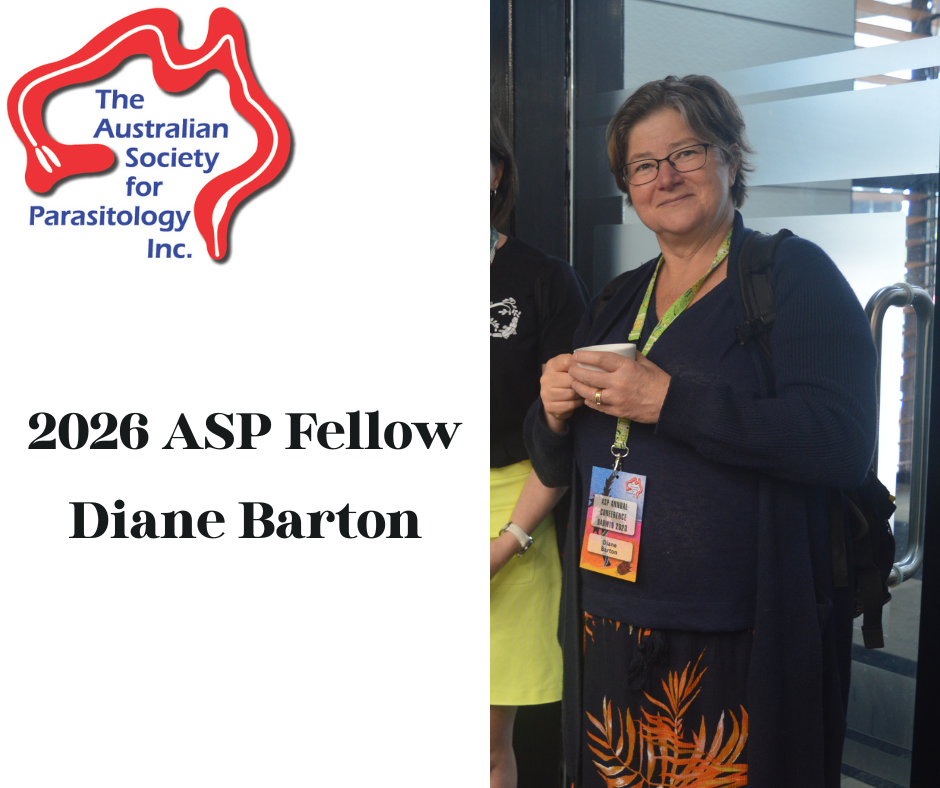
Citation
We are honoured to nominate Dr Diane (Di) Barton for election as a Fellow of the Australian Society for Parasitology. Over the course of her distinguished career, Dr Barton has made outstanding contributions to parasitology in Australia and internationally, encompassing research, education, mentorship, and professional service. Her work has shaped contemporary understanding of parasite biodiversity, ecology, and their roles in fisheries management and wildlife health.
Dr Barton is internationally recognised for her expertise in helminth systematics, parasite biodiversity, and the applied use of parasites in fisheries science. She has published 108 peer-reviewed manuscripts, nine book chapters, three major final reports (FRDC, NESP), and produced an interactive CD, a formidable body of work that spans taxonomy (including descriptions of new genera and species), checklists, parasite ecology, and population dynamics. Her research has introduced parasites as valuable biological tags in fisheries management, and her influence extends across academia, government, and applied biosecurity.
Her work has been supported by substantial research funding as principal researcher on collaborative projects, most notably through FRDC grants under NT Fisheries. These projects have provided crucial insights into parasite roles in host population ecology, fisheries stock discrimination, and biosecurity risk assessment.
Among her many landmark studies, Dr Barton’s research on the cane toad (Rhinella marina) stands as a foundational contribution to Australian parasitology. She conducted the first full documentation of parasites in cane toads in Australia, tracing their origins whether introduced or acquired locally and comparing parasite faunas in native frogs. This groundbreaking work led to the description of three new species, including one new genus and one new subgenus, followed by three further species based on the same collections. Her research was also the first in Australia to explore parasite community ecology in wildlife, assessing the impact of infection on host health and potential for biological control. Her checklist of amphibian parasites in Australia remains a key reference in the field.
In the realm of fish parasitology, Dr Barton has described 27 new species, two new genera, and proposed three new combinations, significantly expanding knowledge of aquatic parasite fauna. Her studies have firmly established the use of parasites as standard tools for fisheries management, applied across ten fish and shark species within the Northern Territory Fisheries portfolio. These contributions have deepened understanding of host ecology, stock structure, and the environmental dynamics influencing aquatic systems.
Her interests also extend to the parasites of reptiles, with a particular focus on pentastomes, where she is currently the only active Australian expert in taxonomy. She serves as the sole Australian member of an international panel investigating the introduced Raillietiella orientalis, a species with devastating impacts on reptile populations across the Americas. Her broader work on reptilian parasite taxonomy complements her comprehensive approach to biodiversity and host–parasite interactions.
A passionate educator, Dr Barton has taught parasitology at James Cook University, the University of Adelaide, Charles Darwin University, Charles Sturt University, and the Australian National University. She has supervised 17 Honours, 3 Masters, and 2 PhD students, many of whom have progressed to successful research careers. Through her teaching, she has integrated parasites into zoology curricula, using innovative field-based approaches for example, running practicals where students examined fish morphology and ecology through the lens of parasitism.
Dr Barton has been an inspiring mentor to emerging and female parasitologists, leading by example and fostering a culture of curiosity and collaboration. She has supported students and colleagues informally, sharing her expertise generously.
Dr Barton has been a continuous member of the ASP since 1989, serving as Queensland State Representative (2001–2002), presenting numerous talks and posters, and contributing to ASP Science Week events such as parasite art workshops and public outreach sessions. Her achievements within the Society include:
- Best Student Paper (ASP 1993)
- Invited Plenary Speaker (1989, 2025)
- Editorial Board Member, IJP: Parasites and Wildlife (2025–)
- Frequent reviewer for IJP and IJP:PAW
Her enduring commitment to the Society and her advocacy for integrating parasitology into broader ecological and management contexts exemplify the spirit of the ASP.
Dr Barton’s career also illustrates adaptability and resilience. As the spouse of an Australian Defence Force member, she has relocated frequently, transforming what could have been a limitation into an opportunity for multifaceted contributions across academia, government, and applied research. Her current work in marine and aquatic biosecurity applies parasitological principles to government policy, particularly in the management of marine pests and ballast water, bridging research and real-world application.
Through her 108 publications, extensive student mentorship, leadership in taxonomy, and integration of parasitology into environmental and fisheries science, Dr Barton has made profound and lasting contributions to the discipline. Her record exemplifies scientific excellence, mentorship, and service, making her an outstanding candidate for election as a Fellow of the Australian Society for Parasitology.
In the light of these contributions to parasitology and the ASP, we would like to nominate Diane Barton as a Fellow of the ASP.
ASP Fellows, Professor Shokoofeh Shamsi and Em. Professor Lesley Warner
